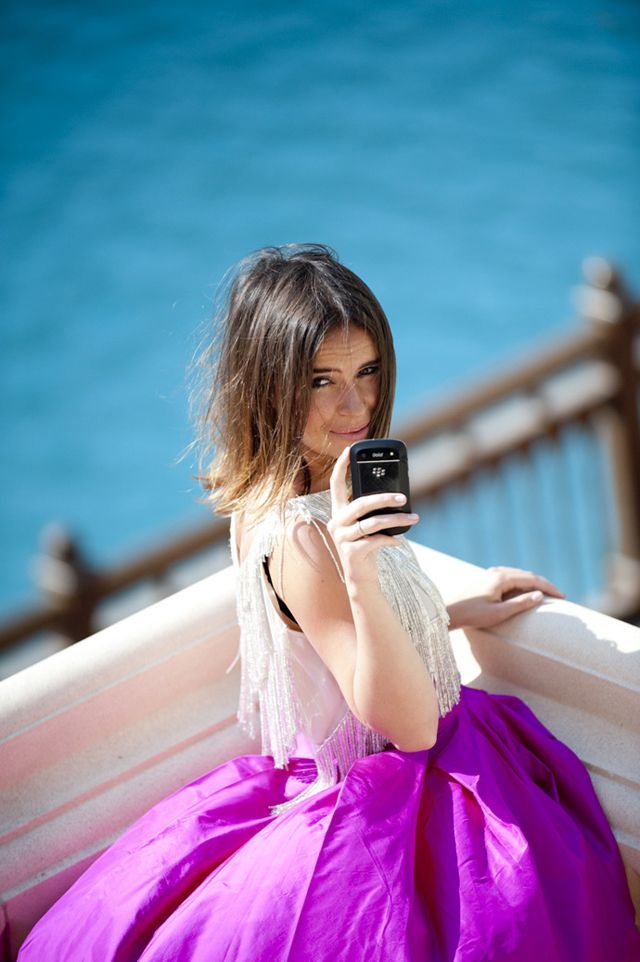
Awesome Last Minute Spring Break Specials! (details inside)

It's been a long winter in MN.... and we celebrate that so many of our guests are booking a plane ticket and going on SPRING BREAK!
Pack your tank top and swim suite - but don't worry beaute' - - we've got your covered -- Or UN-covered!
Check out our awesome last minute waxing specials to prepare you for your Spring Break getaway (or just to get away from the kiddos)! There's no need to show up to the beach looking like a German native who hasn't shaved her legs or arm-pits for the year. Nasty.....

Enjoy our Spring Inspired Specials - and don't forget to add a Keratin Express Hair Treatment or Oxygen Facial when you bless us with your presence!
All discounts are valid through March. Availability for skin services: Tuesday, Thursday, Friday, and Saturday
EMAIL US TODAY: schedule@kasiaorganicsalon.com TEXT US: 612.824.7611 CALL US: 612.824.7611
Download: Beautiful Health Mobile APP - smart, stylish, and instant savings!


Our new Kasia iPhone and Android app makes it easy to get instant access our exclusive deals, track last minute openings and schedule appointments via email--all in real time. But there’s more! You can also give us feedback on your service and be rewarded, find our location and link to our social web updates!
Download the app, refer and share with a friend, and receive a discount on your next service!

General Features:
-Browse our hair and skin services.
-Receive updates on "what's new" and last minute specials.
-Quick contact features, including single-click calling, e-mail, and directions.
-Stay informed of the latest trends and women’s health news on our Blog.
-View inspiring photos for your new look!
-Share our app with friends, refer them in for a service, and both will receive $10 OFF your next service.
-Connect to us on Facebook & Twitter….and much more!
Follow the LINK to the APP store now!
IPhone or Android Google Play
We continue to update our new App. Please let us know if you encounter any bugs!
STRESS Biologically AGES You: Learn WHY and HOW you can turn it back.

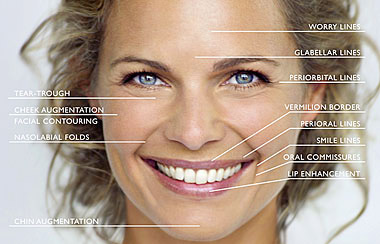
The New Biological Clock: How you can turn it back
Guest Post: Thea Singer, Telomere Expert
Every stress leaves an indelible scar, and the organism pays for its survival after a stressful situation by becoming a little older.
Telomeres sit on the very tips of our 46 chromosomes, which are the threadlike bodies in the nucleus of cells that carry our genes. Telomeres have been compared to the plastic tips on the end of shoelaces—they protect the chromosome from being damaged. As cells replicate, which many do constantly, the telomeres wear down. In healthy times, the enzyme telomerase comes to the rescue, topping off the fraying ends with dabs of telomere DNA; otherwise the cells would stop replicating and die. But telomerase production slows with age; generally speaking, older people have shorter telomeres than younger ones. So do people living with constant stress, Nobel Prize winner Elizabeth Blackburn and UCSF health psychologist Elissa Epel found.

In the above illustration, the yellowish tips are the telomeres. As you can see, each time the cell divides—one cell becomes two, two become four, and so on—the telomere gets shorter. That's what makes telomeres a marker of biological aging—their length indicates the age of our cells. Research shows that people who perceive themselves as being under chronic stress have shorter telomeres by a shocking 10 years or more. But as my book, STRESS LESS, shows, there are many research-backed interventions you can do yourself to slow or even reverse that aging process.
Margie E. Lachman’s office at Brandeis University, where she is a professor and the chair of the Department of Psychology, is enormous and sunlit. Impressionist oil paintings on loan from the school’s famous Rose Art Museum illuminate the walls, and gifts from students—glass flowers, a model of a Vietnamese “longevity” turtle—rest alongside a blue and yellow tin of Lucy’s Predic-a-Mints, of I Love Lucy fame. Lachman, a cheerful, wholesome-looking woman with rectangular glasses and dark wavy hair swept up in a silver barrette, clearly mixes whimsy with her academic rigor.
Lachman specializes in the area of life span development, including the sense of control we feel we have (or don’t have) in adulthood and old age. She was one of the original investigators on the massive study Midlife in the United States (MIDUS I), launched in 1995 to explore the health and well-being of more than seven thousand Americans, and she continues as an investigator on the study’s ten-year follow-up, MIDUS II.
I’m talking with Lachman to try to understand why we baby-boomer women may be the most stressed-out beings on the planet. “Stress is highest in young adulthood and midlife,” Lachman writes in the scientific paper that brought me here. These adults, she continues, “experienced more frequent overload stressors, especially involving children and financial risk.”
Why might that be? For starters, midlife in general presents unprecedented challenges, say social scientists, leaving us more vulnerable to day-to-day stressors from the get-go. It’s at midlife that we become aware of our mortality. Our bodies are no longer under our control the way they once were: no more reversing Friday night’s chocolate-cake binge with one day of Boca burgers and egg whites. Our health—and that of our partners—is increasingly precarious. “We find that a lot of people, as they get older, think that aging is just this inevitable, irreversible process of decline,” Lachman tells me, noting that such thinking can work against us. Lachman knows whereof she speaks: She’s a baby boomer herself—one of the forty-two million women between the ages of forty and fifty-nine living in the United States, according to U.S. Census Bureau data from 2005. It’s a group that comprises more than fourteen percent of the total American population. “The beliefs that people hold regarding aging really do have an impact in terms of how they behave and how they react and what the actual outcomes are,” she says. “People who feel that they are not in control of aging actually look different from people who feel that they are.”
No control. It lies at the heart of everything stressful, to a greater or lesser degree. The economy is in terrible shape. We (and our graying mates) are losing our jobs—maybe even struggling to hold on to our homes. We are caring for growing children with one hand and aging parents with the other, while also trying to save for those kids’ college and our own retirement. A survey from the Pew Research Center on the “Sandwich Generation” presents the stark stats: A quarter of women—particularly those between the ages of thirty and fifty—reported caring for a parent or other older relative. A whopping fifty-four percent of those in such a caregiving role said it caused them “at least some stress,” and twenty percent of that group said they were under “a lot of stress.”
Also adding to the burden is the fact that most of us work outside the home for economic reasons, even as we continue to do the lion’s share of housekeeping and child care (we’re expected to bring home the bacon and fry it up in a pan, to paraphrase the old Enjoli perfume ad). Compounding the pressure is that our workplaces are often unsupportive of our multiple roles. If we work on our own as consultants, as more and more of us do as companies shrink, we also have to deal with the loss of work camaraderie and hours of social isolation. (And no, Facebook, virtual office that it can be, does not replace that chat by the watercooler.)
And unlike other generations, we cut ourselves little slack. Boomer women essentially invented the Superwoman syndrome—we would do it all, for everyone, and do it well. Now, at midlife, we’re taking stock, questioning whether we’ve achieved what we could or “should” have—and invariably beating ourselves up for falling short. Baby-boomer women “even made parenting a competitive sport,” notes Cornell University’s Elaine Wethington, a medical sociologist specializing in stress and midlife, in an article in the university’s publication Human Ecology. “It wasn’t enough to have and raise children. They had to have perfect children.”
Such demands can have a steep price: One of Wethington’s recent studies shows that a quarter of American women have had at least one episode of depression—a rate twice that of men.
It’s not just the major stressors that do us in—job loss, death of loved ones, long-term debt. The daily hassles—family fights, traffic, work deadlines—take their toll, too, piling up like bumper-to-bumper cars on a weak bridge. David M. Almeida, Ph.D., a developmental psychologist at Pennsylvania State University, has subjects in his studies fill out daily stress diaries over various periods of time so he can assess how overloads occur. In a weeklong study, he and colleague Melanie C. Horn, Ph.D., found that young adults and those at midlife reported more days with stressors, more days with multiple stressors, and more frequent “overload stressors” than older folks did. More support for Lachman’s contention. I wasn’t surprised.
 “It’s at midlife when we are pulled in many directions in terms of being responsible for others, from our own children to our aging parents,” says Almeida. “It’s also a time when we’re more likely to be in management positions at work. All of these things expose us to more ‘danger’ events, the most prevalent types of stressors.” Danger events, he explains, are those that lead us to worry about the future—for example, hearing that the company’s revenues are down just when your son goes off to college, or that your mother, two hundred miles away in New Jersey, has been taken to the emergency room by ambulance. “We’re in the driver’s seat, which supposedly would give us more control,” he says. “But we also have more responsibility.”
Such repeated stress frazzles us. It makes us snap at our partners and kids—even growl at the dog. It keeps us awake at night and clouds our professional judgment. We’ve known for years that it puts us at greater risk for any number of diseases. What we didn’t know until now is that it actually physically ages us, all the way down to the DNA in our cells.
It was through such stressed women—they were caring for their chronically ill children—that2009 Nobel Prize-winning cell biologist Elizabeth H. Blackburn, Ph.D., and health psychologist Elissa S. Epel, Ph.D., both at the University of California, San Francisco, made the groundbreaking discovery from which this book sprang: that chronic stress literally gnaws at our DNA—its tips, or telomeres, to be precise—speeding up the rate at which our cells age by an alarming ten years or more.
The implications are clear: For us midlifers, stress has become the new biological clock.
Yet, as the research in this book will also show, there’s good news to go along with that shocking discovery—ways that we can slow, and even turn back, that relentless timepiece. For the Epel and Blackburn findings also reveal that what matters in cell aging is the level of perceived stress, which means that the antidote lies, significantly, in our own hands—or, more precisely, in our minds and our behaviors.
Of course, no scientist would ever suggest that we eliminate stress, whether psychological or biological. Indeed, as stress guru Bruce S. McEwen, Ph.D., puts it, if we got rid of stress, “we’d be dead.” Director of the neuroendocrinology laboratory at the Rockefeller University, in New York City, McEwen has been a leader in the study of stress for decadess, training generations of young scientists who make up a veritable who’s who of stress researchers.
Temporary, or acute, stress, in fact, can be very good for us. Exercise is a prime example. Researchers such as Gordon J. Lithgow, Ph.D., at California’s Buck Institute for Age Research, have shown that acute stress can even extend lifespan. Lithgow, a lanky, enthusiastic man with a broad forehead and inquisitive eyes, studies stress and aging in that most elemental of beings, single-celled worms (C. elegans). He’s shown that acute stressors—say, increased temperature for several hours—enable the worms to live up to thirty percent longer than their nonheated peers. How so? The added heat perturbs the homeostasis, or internal constancy, of the worm’s single cell. The cell in response kicks out what are called heat shock proteins, which, in a process called hormesis, causes the cell to metaphorically thicken its skin, making it better able to withstand future insults that could contribute to its demise. (We have homeostatic systems, too, as you may recall from high school biology. An example is body temperature: We operate at full throttle only when it’s near that constant 98.6 degrees Fahrenheit.)
Why do we care about stress in, of all things, worms? Scientists in search of so-called longevity genes—such as the University of Michigan’s Richard A. Miller, Ph.D.; the University of Washington’s Matt R. Kaeberlein, Ph.D.; and Harvard’s David A. Sinclair, Ph.D. — rely heavily on the fact that many cellular responses to stress are conserved throughout evolution. Worms may not be us, but the mechanistic lessons from worms may, they believe, apply to us.
Distinctions also split psychosocial stress—the heart-quickening, stomach-tensing kind we automatically associate with the word stress. Many scientists break psychosocial stress into two categories, and limn how our bodies and brains respond differently to each. There’s challenge stress (good for you), which refers to situations we find demanding but for which we have the resources to cope. Waiting in Whistler at the top of the mountain to slalom to Olympic gold—that’s challenge stress, as is (yes!) sex (see Chapter 3). In contrast, threat stress (very bad) refers to situations that are overwhelming, in which we feel helpless in the face of the onslaught. Caring for a chronically ill child, as the subjects in Blackburn and Epel’s research were doing, qualifies as threat stress.
Stanford University neurobiologist Robert M. Sapolsky, Ph.D., another giant in the stress-research world and author of the acclaimed Why Zebras Don’t Get Ulcers, elaborates. “Our goal isn’t to have a life with no stress—anyone ranging from a development psychologist to a gerontologist knows that,” he wrote in an e-mail before our first meeting. “The idea is to have the right amount of stress. So what’s the right amount? Generally, it’s for challenges/stressors that are moderate in severity and transient in duration. And what does that define? Stimulation. ‘Moderate in severity’—it’s not for nothing that three-minute roller-coaster rides aren’t so severe that they rip your internal organs loose. ‘Transient’—it’s not for nothing that roller-coaster rides aren’t three weeks long. Another way of framing what good stress is: circumstances where you voluntarily relinquish a degree of control and predictability in a setting that overall is benevolent. You’re willing to let yourself be utterly out of control as to when the scary thing happens on the movie screen—because you know that the murderer is going to stay on the screen.”
McEwen, for his part, refines the psychosocial stress categories even further. Challenge stress, he says, encompasses both positive stress, in which you have good self-esteem and relish the chance to rise to the challenge, and tolerable stress, in which “something bad happens, but you have good social support and self-esteem, so you have the tools—economic, personal, and so on—to weather the storm.” Finally, there is toxic stress. “That’s the really bad stuff, where you don’t have adequate resources,” he explains. “Maybe you’re poor, maybe you don’t have good social support, maybe you’ve been abused as a child.” These are the folks who may not be able to rebound, and for whom pathology—major depression, for example—may develop. Blackburn and Epel’s caregivers with the shortest telomeres fit there.
Where do you fall on that stress spectrum? To help you find out, I’ve provided a targeted test at the start of each chapter in this book; use the tests together to develop your own stress profile. Questions they’ll help you answer include: What is my personal stress level? Which behaviors of mine increase my stress level and which ones reduce it? How should I change my lifestyle to bring about the latter so I can slow the aging process? These are not cobbled-together pseudoscientific scales but the actual tests used in scientific studies on stress and the behaviors that inform stress: diet, exercise, psychological outlook, social support, sleep, and more. Indeed, many of them come directly from the studies cited in these pages.
The discussions following the tests delve deep into Blackburn and Epel’s groundbreaking research on stress and aging, as well as that of dozens of other scientists whose hours spent bent over pipettes and petri dishes, crunching numbers from intricate surveys, and analyzing the behavior and brain changes of subjects from rats to people provide crucial new insights into our understanding of stress and how it ages us. They also explore the latest science showing how to manage our stress so we can slow the aging process.
Driving this approach is my own understanding of the mind-set of so many midlife women like me: The how-tos of combating stress are not enough—and not only because we are, constitutionally, it seems, dedicated to understanding the why of things, avidly researching our own health concerns both online and in print. It’s also because, for us, meaning begets action. We act not blindly but with definite intention based on reliable, concrete information we’ve dug up ourselves. We are knowledge seekers. Our old mantra, “Don’t trust anyone over thirty,” has become “Don’t trust the experts alone to tell us what we need to know.”
And so, be prepared to take a collaborative journey inside your body and brain to learn what makes your stressed self tick—and how you personally can slow that clock. The study of how stress contributes to our cells’ aging—which Blackburn and Epel opened the door to—is incredibly new. But be assured: By the time you finish this book, you, too, will be comfortably batting around the word telomere at cocktail parties and the gym, and making the lifestyle choices, based on rigorous science, that speak specifically to you. My intent is not to lay out an ironclad program for you to rigorously follow, but rather to let you, the intelligent and informed reader, pick and choose your strategies for reducing stress. After all, lack of control and unpredictability induce stress. What all of us need, now more than ever, is to trust our own good minds to make our own wise choices.
As Margie Lachman told me: “You can’t stop aging, but you can slow or compensate for it—you can prevent certain changes, or at least minimize them.” That’s what control is about. And control over stress and aging is what this book will teach you, on your own terms.
4 Healthy Hair Solutions to Reduce your Winter Hair Blues

I’ve had lots of clients in my chair recently expressing their frustration about their winter hair woe’s: dry scalp/hair, static, frizz, split ends and a general feeling of ‘ehh’ about their locks. Winter can be tough on your hair and you may need to change your tactics with the season.

Dry Scalp and Hair: We all know the cold air outside makes the hair dry and brittle, but don’t think you are escaping damage by hiding indoors; indoor heating can be just as damaging.
The fix: use a shampoo/conditioner with moisturizing properties such as shea or aloe. Up your conditioning treatments if you have thicker fuller hair and those with finer hair consider adding a lightweight leave in conditioner to your hair routine.
 Check out our Replenish Shampoo/Conditioner and our aloe vera based Off the Fritz.
Split Ends:  Dry hair causes split ends and you want to nip them in the bud, so to speak. When the hair begins to split at the bottom it will keep splitting until you trim off those ends.
The fix: Call and book a haircut with your stylist now! I can’t express how important it is to keep up with your trims to maintain beautiful healthy looking hair.
Frizz/Fly-a-way: Without the moisture, you may find yourself with some seriously frizzy or fly-a-way hair – even without wearing hat.
 The fix: Try our brilliant Outshine, pure argan oil based smoothing gloss; it’s a winter must. For extra soft smooth finish, add to your conditioner or right before you blow dry, continue use as needed. Argan is lightweight which makes this a great product to “layer”.
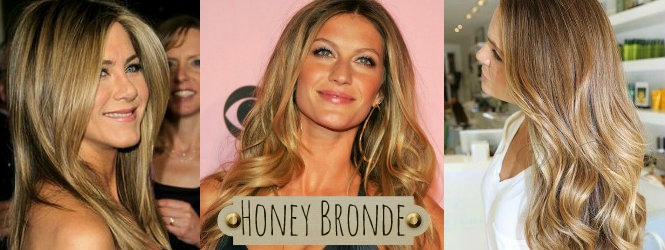
Dull Color: We tend not to see as much of the sun in the winter and it can wash out your complexion.
The fix: An easy way to rid yourself of the winter hair blues is to refresh your shade or add a few sun-kissed highlights.
Give us a call at Kasia Organic Salon and see how our healthy hair experts can help cure your winter hair blues! 612.824.7611
Author: Valerie, Kasia Hair Health Expert and Stylist
HAIR LOSS AMONG WOMEN IS ON THE INCREASE

Hair loss is common and growing in younger women. Changes in lifestyle, increased exercise or weight loss, malabsorption, the way we style our hair and also use of birth control pills could be factors.
Lifestyle
Stress typically will increase testosterone levels and trigger and/or worsen hair loss and hair thinning in genetically pre-disposed. Our demanding lifestyles are stressful – and one could argue that this past decade has been an onslaught of failing economies, unemployment and increasingly competitive work environments. I'll speak for myself, many of us do not take the time we need to relax.
Another fact is that stress can cause or trigger flare-ups of dandruff – and dandruff has been proven to worsen hair loss in some instances.
Oral Contraceptives
Oral contraceptives are being used more widely– and also among younger women. While certain birth control pills have the ability to help slow or stop hair loss and thinning, others can cause it. The latter contains androgens (male hormones), which can trigger hair loss in women with follicle sensitivity.
Diet
Unhealthy and restrictive dieting regimes are, unfortunately, still popular and  fashionable – and with every year a new fad crops up; from juice fasts and ’miracle’ shakes, to no-carb or no protein meal plans. Being low or over weight can certainly cause hair loss. Note, you can be either of these to be malnourished.
Hair cells are the second fastest growing cells in the body, yet they are not cells needed for survival.
Hair Extensions
Hair extensions are now more popular than ever. Our hair experts use the best on the market that are "tape extensions" and non damaging to the hair.
Average Life-Span
Hair loss may also be on the rise simply because people are living longer. Hair thinning is more common in all individuals as they age, and in women is especially more common after menopause due to falling oestrogen levels. Certain medical conditions and poor health also tend to be more in older age groups – and general health plays an important role in the maintenance of hair growth.
Contact our team today for a consultation - great color or cut suggestions - or women's health questions pertaining to sudden or long-standing hair loss.
References: Kingsley Hair Center
Quick Guide to "Hairy" Science Terms

As a stylist, I realize sometimes our team may ramble about technical hair words like "cuticle" or "melanin" or a certain color level. In reality, you are wondering where to put the keratin - is it inside the cuticle or over the melanin? It's now our intent to confuse you!
To clear the air, we've put a "Hair Dictionary" of those tough terms your stylist may use.
 Hairy Science Terms
Cuticle Layer - The outmost layer of your hair, which kind of resembles scales. Most likely, you have seen an image of hair cuticle on a shampoo or conditioner bottle, or even on the television. At it's healthiest point, the cuticle will be shiny and smooth, at its worst - dull and brittle like a palm tree trunk.
Cortex - Located under the cuticle and contains pigment (known as melanin) which gives your hair color.
Hair Follicle - The slant in the scalp where hairs form and are anchored.
Hair Cycle - The phases in which hair growth occur. The first is anagen, in which hair is growing. Generally, this stage lasts between 2-7 years. The next two-week long stage is categen, in which hair detaches from the follicle and falls out. The final stage is telogen, in which new hair will begin to form as cells divide. This phase lasts for 2-4 months.
Keratin - The main component of hair and nails. Results in the health and shininess of hair.
Melanin - Two types exist; eumelanin (brownish black) and pheomelanin (reddish yellow). The combination of the two determine how light or dark one's hair is.
Sebum - A gland in the scalp that produces fat necessary to prevent the scalp from drying out.
Styling Terms
Texturize - This term simply means to add movement and a variety of lengths to a style. Generally, a texturized style is more of a "blunt" cut.
Graduation - Adding weight to the hair cut. Generally, the weight build up is 45 degrees from the head shape and adds a TON of movement to hair.
Dusting - Cutting the least amount of hair off possible. Think of it as a super trim.
Gloss - Finishing product that adds a layer of shine to hair.
Glaze - Adds shine and slows down the hair color fade process. Unlike gloss, a glaze is semipermanent.
Fillers - Even out hair color. In general, fillers are used before hair is dyed.
Oxidation - Change in hair color due to, you guessed it, oxygen in the air. Generally causes a yellowing of hair.
Spot Foil- Typically for clients that retouch frequently. Nice set of foils around the face - less than a partial foil.
Which hair terms have have we missed? Let us know!
How to Wear the Color of the Year: Orchid! (hair and makeup tips inside)
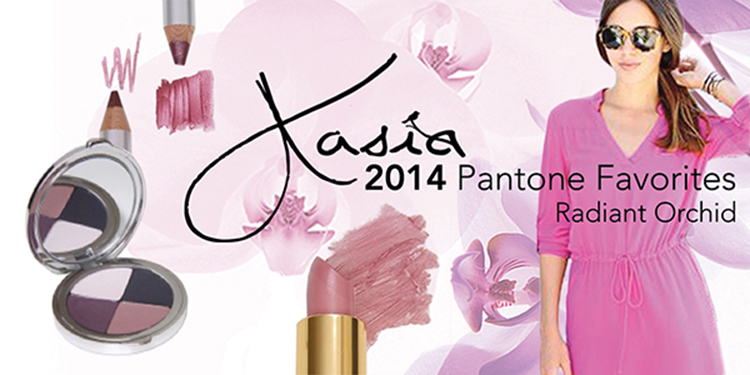
Move over Barney, there's a new purple in town!
The Pantone Color of the Year is called “Radiant Orchid”—a powerful purple tone that lives somewhere between cold, blue tones and warm, red nuances. Somewhat Fucia but heartier than lavender; less alarming than grape; and too gutsy to be barbie pink.
Start early because you're about to see it everywhere…in fashion, cosmetics, hair color, home décor, even wedding palettes.
Purple is growing on me, and I can name a few clients that obsessively ADORE! Moderation is a good thing. I wouldn’t buy it in a car, but I could be persuaded to a great spring clutch or a ballet flat, or scarf.
Hair Color? Well, if you ask. The "Best Of" this high-maintenance shade:
Radiant Orchid clothing looks best on a deep redhead; a dark, cool brunette; or a very pale, icy-blonde. Those that want to color their hair purple— well, that's not for the faint at heart.
More than anything, you will see these tones ALL OVER the cosmetics counters. This is the best, easiest way to let some of this radiance into your life.
Here’s our top La Bella Mineral Makeup choices to check out at Kasia:
Duo-Lip Crayons 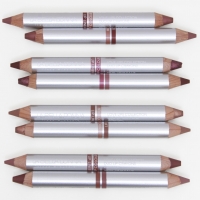 The natural antioxidants duo-ended crayons are richly pigmented and designed to line, define and enhance your pout. A high level of precision, as well as smoothcoverage. The soft, rich colour pay-off makes this formulation a favorite used among makeup artists.
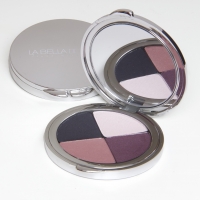 Venti Ann Eye Quad
“Star” is the lightest shade of sparkle which can be used as a highlighter below the brow; in the inner creases of the eye and on the lid. Use the depth of “Twilight””in the crease and in the outer corners of the eye. “Night””is a perfect splash of black to create any smoky eye. Use it wet for a liquid eye- liner. A light dusting of “Sweet Dawn””on the cheeks which can also be used as a pop of colour on the eyes.
Venti Ann Eye Quad
“Star” is the lightest shade of sparkle which can be used as a highlighter below the brow; in the inner creases of the eye and on the lid. Use the depth of “Twilight””in the crease and in the outer corners of the eye. “Night””is a perfect splash of black to create any smoky eye. Use it wet for a liquid eye- liner. A light dusting of “Sweet Dawn””on the cheeks which can also be used as a pop of colour on the eyes.
Mineral Light Lip Colour
Highest level of mineral pigment for color on the market, followed by Ceramide 2, which is designed to keep lips smooth and protected from the sun’s damaging UV  rays. Add a little vitamin C and enjoy the finish of rich, creamy with a satiny texture and lush shine.
Get Natural Coverage: Contains no petrolatum, free of preservatives, dyes or lanolin derivatives. Dermatologically approved.
I am going to ease in with a few orchid splashes throughout my home and I just may try some plum-up nail polish on my toes as sandal season closes in. Ughhhhh.....Sounds good right about now, doesn’t it?
Contact the Kasia Team today to PLAY with new colors of inspiration for 2014. Here are few favorite captured PINS! Until next time....xo